



Please note, these FAQs will be updated as the newly funded GW4-HP2 programme details become available.
This section provides detailed answers to common and more complex questions about the GW4-HP2 Programme. We encourage you to read through the FAQs carefully, as they offer valuable insights into the structure, expectations, and support available. If you have any further questions or require clarification, please don’t hesitate to contact the hub team.
Last updated: September 2026
Q: What is the current call timeline?
See our Timelines page
Q: How many offers do you make each year?
We are funded to make five doctoral appointments each year for PhD start dates during the years 2027-2031 inclusive.
Q. Wellcome do not traditionally fund some aspects of health research, has this changed?
Wellcome Trust has funded us to deliver PhD projects focused on discovery science, biomedical-related fields, however, they do not expect all projects to fall under their strategic priority areas.
The infographic below indicates the areas of research strength within the region. The expertise available in the form of methodological and technical excellence offered by the institutions in the consortium will add value to your research question by bringing experts into your supervisory team.
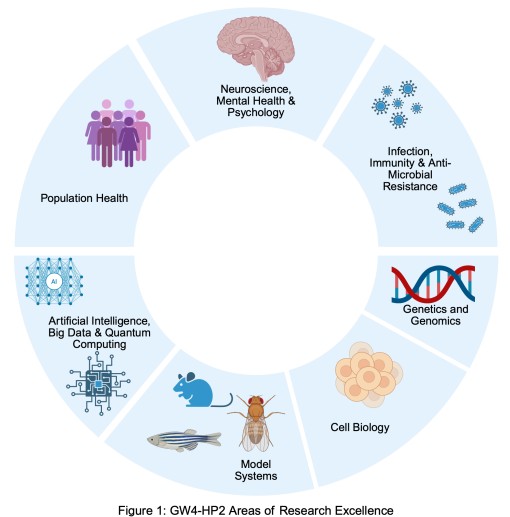
We are unable to fund clinical trials, and do not generally fund social sciences research.
Details of the types of bio-medical related projects that the programme has funded previously are detailed on ‘Our Fellows’ page.
Q. Will there be specific areas of research that are prioritised for funding?
We do not prioritise specific areas of research, we focus on excellence, identifying candidates potential to become a skilled researcher and clinical academic of the future.
Expectations of the funder
Wellcome’s intended short-term outcomes:
• To fund bold and creative high-quality research
• To support capacity building of clinical academics
• To create and support positive and enabling research ecosystems
Wellcome’s intended medium- and long-term outcomes:
• To build and empower a diverse and creative clinical academic workforce that can solve urgent health challenges and bring new insights into how life works
• To positively transform the culture that health research is embedded within
Q: What health and care professionals are accepted onto the Programme?
The Programme is open to health and care professionals, including vets, who are fully registered with an appropriate professional regulatory body in the UK or Republic of Ireland.
Applicants must:
- Be practising health or care professionals (including veterinary professionals).
- Hold current registration with a recognised national professional regulatory body in the UK or Republic of Ireland (for example, the General Medical Council, Nursing and Midwifery Council, Health and Care Professions Council, General Dental Council, General Pharmaceutical Council, or Veterinary Council of Ireland/Royal College of Veterinary Surgeons, as applicable).
- Meet any profession-specific requirements outlined below.
Additional requirements for medical graduates
Medical graduates must either:
- Be enrolled in a recognised specialty training programme in the UK or Republic of Ireland; or
- Be a registered General Practitioner (GP).
Q: What kind of research experience do I need?
Applicants are likely to have previously undertaken research, such as an Academic Clinical Fellowship (ACF) or clinical primer or equivalent (medical and dental graduates), an internship, residency, clinical primer or equivalent (veterinary) or via an alternative route such as the NIHR ICAT fellowship, or a research master’s degree with relevant modules.
We would typically like to see that you have previous research experience including disseminating findings.
If you are unsure whether your research experience is appropriate for an application to GW4-HP2, please contact the programme team on GW4-CAT@bristol.ac.uk who can advise further.
Q. Do I need to have publications from my previous research?
Ideally you will be able to demonstrate some output from your research, which may not be in the form of a publication, as we appreciate that not all health and care professions have the opportunity or support for high impact publications.
Q: Do I need to have intercalated during my degree to be eligible?
No, intercalation is not a requirement for the GW4-HP2.
Q: Do I need to have taken an academic medical or dental foundation training path to apply?
No, not all dental or medic GW4-HP2s will have followed the academic foundation programme path. As long as you have evidence of research experience, a clinical foundation path will not put you at a disadvantage.
Q. As a non-medic health professional, how can I be competitive for a place on the GW4-HP2 programme?
We appreciate that not all health and care professionals have access to a period of funded research during their training. To take this into consideration, all applications will be taken on their individual merit so that the strongest candidates will be shortlisted for interview by an appropriate panel. The Shortlisting Criteria by which applications are assessed.
Q. Can I apply to GW4-HP2 to part-fund an existing research project?
No. The scheme does not part-fund existing research.
Q. Do I need to include a project proposal with my application?
We do not require a finalised project at application, but we do need to know in detail what area of research you want to pursue. In assessing your application, we would like to understand this to see that you have considered your area of research and the potential supervisors / skills that are available within the GW4-HP2 Programme.
This is useful for working with the directors and supervisory team to design and write a PhD project during the pre-PhD period.
Q. Can I (and/or my supervisor) propose a research project?
An important aspect of the GW4-HP2 scheme is developing a project idea in the pre-PhD period. The GW4-HP2 fellow will design their own project, supported by their supervisors and the programme directors; the fellow will take ownership of the PhD research project.
Q: When is the best time during your medical or dental training to complete a PhD?
Candidates from medical and dental specialities on an uncoupled training pathway are eligible for enrolment at any point after securing a higher specialist training post. Applicants on this pathway may apply during their CT2 or CT3 years as long as they secure a higher specialist training place before the commencement of their PhD.
Q. Can I apply for a PhD on this Programme if I am finalising my undergraduate degree?
Undergraduate students are not eligible to apply for this Programme, but those undertaking an appropriate master’s degree may be considered
Q: What funding does GW4-HP2 offer?
See our ‘Funding’ page.
Q: How long does the funding last for?
The standard duration of a GW4-HP2 fellowship funding award is three years (full-time equivalent) from the date of registration at your host institution. If taking the fellowship on a less than full-time basis, we expect this to be for duties other than working in a second job, e.g. a caring role.
Q: Where will I be registered for my PhD?
You will normally be registered at the university where your senior supervisor is employed (Bath, Bristol, Cardiff, Exeter, or Swansea). As supervisory teams often include researchers from more than one partner institution, you may also be eligible to register as an honorary student at one or more partner universities. This can provide access to training, facilities, and development opportunities across the consortium.
Q: How much clinical work am I allowed to do while studying for my PhD?
Wellcome Trust and GW4-HP2 will allow you to undertake up to one day per week of clinical work if appropriate to your training or helpful for your research question (up to 8 hours), but the emphasis will be on an excellent PhD experience.
Q. Are any funds available during the period of time required to prepare my PhD outline prior to starting a GW4-HP2 fellowship?
Details of funding available to support the pre-doctoral period will be published shortly.
Q. Do I need to have a master’s degree that is research based?
A research-based master’s would demonstrate that you have some of the relevant skills and training to carry out a period of PhD research. However, this is not a mandatory requirement, and some applicants will have gained research experience through other avenues.
Q. Do I need to be working clinically in the NHS to be eligible?
We anticipate that the vast majority, but not all applicants will currently be working clinically in the NHS. Some though may be working in a private setting such as vets and some pharmacists.
Fellows recruited to the Programme must be practicing professionals and be registered with a national professional regulatory body (e.g., the General Medical Council, Health and Care Professions Council) in the UK/Republic of Ireland.
Q. How many years of clinical experience do I need to be eligible?
Different health professionals have different clinical training pathways, so we do not set out years of clinical experience as eligibility criteria.
Q. Can I retain my NHS employment?
Medics will be employed by the university where their PhD is registered and will be a member of staff and a registered postgraduate student. To carry out your clinical work if required, you will be asked to obtain an honorary contract with your NHS employer and you will be able to maintain your NHS pension.
Health care professionals will be supported under a salary buy-out scheme where funding is provided to your employer to cover your salary costs while you undertake you PhD. This allows your clinical or professional duties to be backfilled, giving you protected time to focus on your PhD and research training without loss of employment status or professional registration.
Q. Do I need support from my employer?
Medics need to apply for OOPR from their Deanery and TPD in order to take time out of training.
As a programme we are keen to ensure that all GW4-HP2 Health Professionals who are offered a PhD Fellowship, are appropriately supported by their NHS Trust (or equivalent employer), if they wish to return to their clinical post after the 3-year PhD.
We therefore request that health and care professionals submit a letter of support from their NHS Trust, Clinical Director and Chief Executive with their application form. We have drafted a downloadable Template letter
In summary the letter needs to provide confirmation that you will
- be released for the total amount of research time for the three years full time equivalent for which you are funded
- be given the opportunity to work to retain clinical skills for the duration of the programme
- be able to return to your current role when the programme ends as the backfill will be temporary for the duration of your study
- retain your employment and pension rights and there will be no disruption to continuous service in the NHS whilst on the doctoral programme
NB This is not a requirement for medical doctors who will seek approval for out of programme from their Deanery and training programme director.
Q. How many times can I apply to the programme if I am unsuccessful initially?
Programme policy is to accept a maximum of two applications per candidate.
Q. Can I do the PhD on a part-time basis?
Yes, you can do your PhD on a part-time basis, but only to balance this with caring responsibilities, not in order to carry out other salaried employment.
Q. Can I retain some clinical sessions during the PhD and would Wellcome pay for this time?
Wellcome Trust and GW4-HP2 will allow you to undertake up to one day per week of clinical work if appropriate (up to 8 hours) as part of your funded fellowship.
Q. I am employed at consultant level, will Wellcome cover my salary during the PhD?
The scheme is designed for those in training or at a comparatively early stage of an established post who wish to develop an academic career. A consultant (or equivalent) salary will not be covered.
Q. What options are there for post-doctoral funding?
Our partner scheme the MRC-Funded Great Western Clinical Research Alliance (GWCRA) is funded to support post-doctoral positions within the region, across the five GW-HP2 Institutions, Bath, Bristol, Cardiff, Exeter and Swansea, and also includes UWE and Cardiff Metropolitan University. There are two call per year to the scheme, further details will be available shortly on the website, when it is launched.
Q. Can I have supervisors from a range of institutions including international?
The supervisory team will be made up of several individuals. Your supervisor will be the lead academic at your home institution. However, other co-supervisors who add value to the project are also welcome. International collaborators can be included if they add significant value to your PhD project.
This list of FAQs will be reviewed and updated regularly as the GW4-CAT HP Programme evolves.